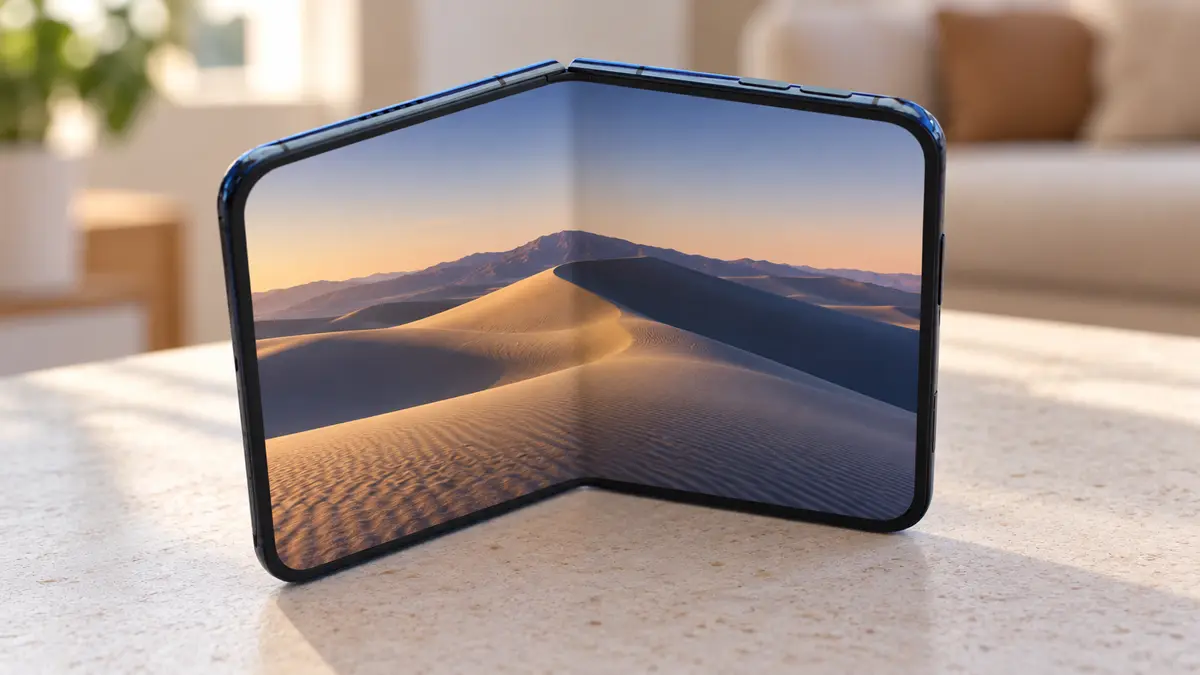
A friend sends an address while you are looking through photos from the weekend. You open the map, return to the conversation, then go back to the pictures. Each task is simple; fitting them into one small screen is the awkward part. The new iPhone Duo approaches that familiar moment with a physical change: open the phone like a book and a much larger display appears.
Apple’s first foldable iPhone reached its initial launch markets on 23 October 2026. It brings a 5.4-inch outer screen and a 7.6-inch folding inner screen together in one device, with software designed around the movement between them. Closed, it handles the quick interactions that fill a normal day. Open, it creates room for photographs, video and more than one activity at a time.
The interesting part is how many roles that shape can take. A slight bend turns the screen into a freestanding viewing surface. Opening it fully creates a small workspace. Turning it over gives the person in front of the camera a view of the photograph. These are the ideas that give the Duo its own identity within the iPhone family.
A new shape for the everyday iPhone
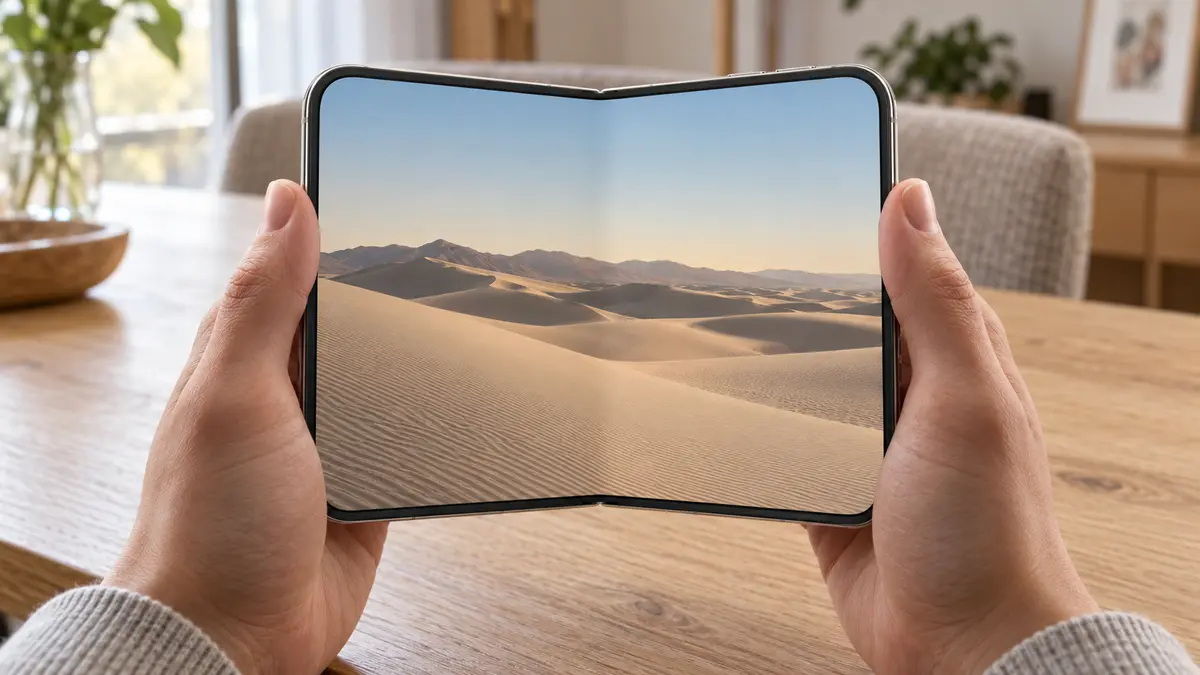
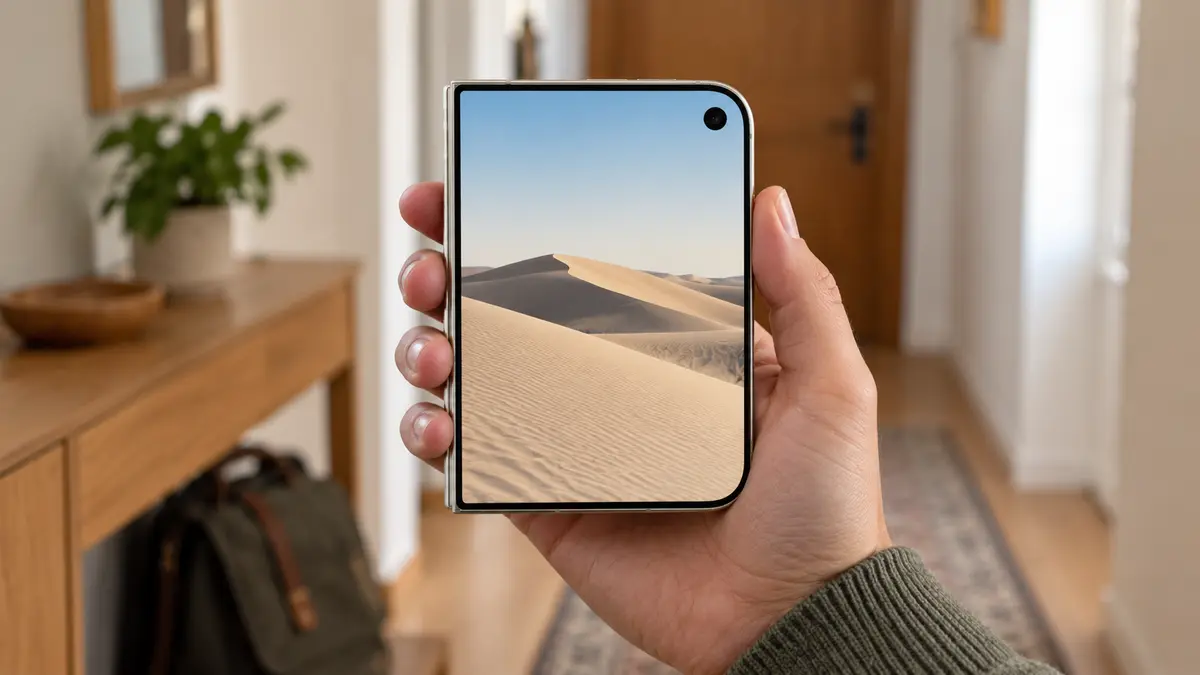
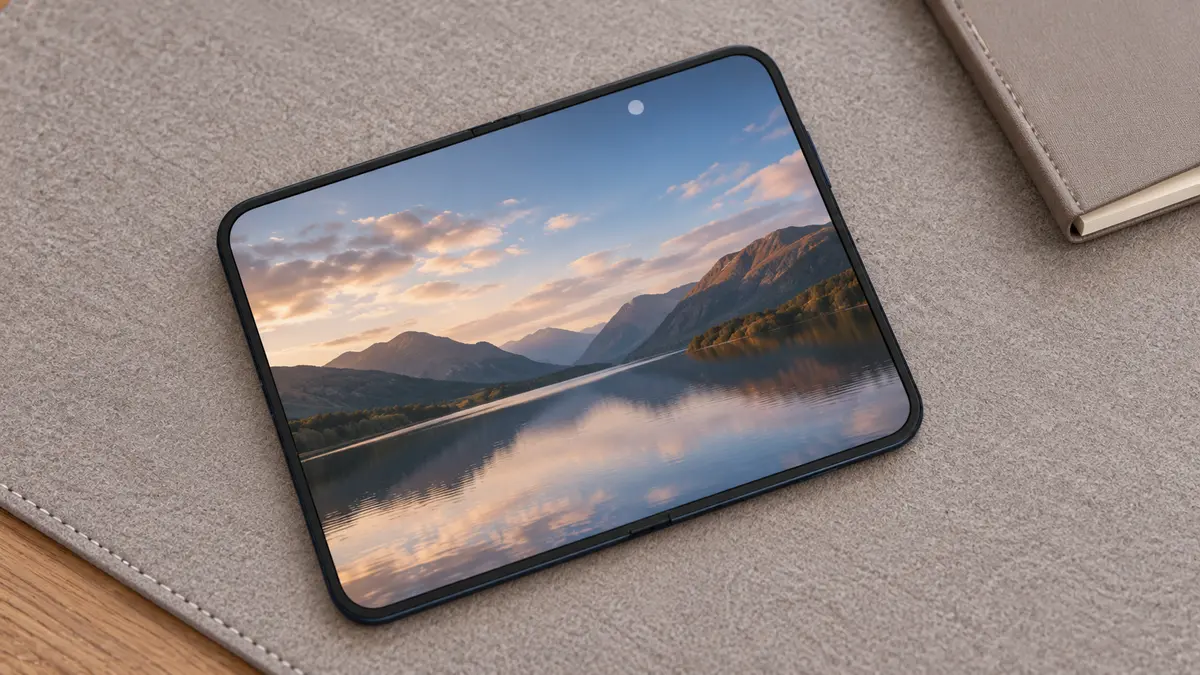
The closed Duo has a noticeably broad, short outline. At 117.8 mm tall and 84.1 mm wide, it resembles a small notebook more closely than the tall rectangle associated with most smartphones. Opening it increases the width to 164.6 mm while retaining the same height. The resulting landscape shape makes its purpose immediately clear: there is space to spread information across the screen.
That transformation also changes how the phone occupies a hand or a pocket. Its specified body depth is 5.2 mm when open and 11.3 mm when closed, and it weighs 254 g. The thin open halves are part of the appeal, while the folded dimensions describe the object carried around during the day. A wider grip may feel reassuring to one person and more demanding to another, especially when reaching across the outer screen.
The two configurations give the same phone quite different proportions:
Characteristic | Closed | Fully open |
|---|---|---|
Main screen in use | 5.4-inch outer display | 7.6-inch inner display |
Body width × height | 84.1 × 117.8 mm | 164.6 × 117.8 mm |
Specified body depth | 11.3 mm | 5.2 mm |
Natural role | Quick messages and everyday phone tasks | Viewing, reading and working across a larger area |
Screen diagonals describe only part of that change. Shape determines how much of a page, photograph or conversation feels comfortable to view, and rounded corners reduce the usable area slightly. The Duo’s appeal comes from being able to change that viewing area when the task changes.
A larger display with a familiar rhythm
Both screens use OLED technology, in which individual pixels produce their own light, and support ProMotion at refresh rates up to 120 Hz. The refresh rate describes how often the display updates; a higher rate can make scrolling and movement appear smoother. Having that capability on both surfaces should help preserve a consistent feel when moving between the closed and open phone.
The inner display adds a nano-texture finish intended to reduce glare. Reflections can be distracting when reading beside a window, particularly across a broad screen, so controlling them has an everyday purpose. The finish is also designed to make the central crease less noticeable. Its appearance will still depend on lighting and viewing angle; a photograph alone cannot establish how visible the fold will feel in use.
The stated outdoor peak brightness reaches 3,000 nits, a unit of display brightness. That describes a peak operating condition rather than the brightness used continuously indoors. For a reader, the more useful distinction is between opening a map in daylight and watching something in a dim room: those situations ask different things of the same display.
A large panel also makes a difference before any multitasking begins. A family photograph can show faces more clearly at a comfortable distance. A document can leave more of its layout visible. A film still retains its original proportions, however, so black bars may remain around wide content. The extra area gives software more room to work with; the content’s shape still matters.
iOS makes room for two things at once
The Duo arrives with iOS 27.1, including layouts that respond to the folding design. On the shorter, wider outer screen, many controls move to the side, leaving more vertical space for the content. Similar arrangements appear across the inner display, with controls adapting to orientation. The change affects where a thumb reaches as well as how an app looks.
Split View allows two apps to occupy equal halves of the inner screen. Imagine, for example, checking a date in an email while looking at a calendar beside it. The benefit is that both pieces of information remain visible. There is less need to remember one detail while switching away to find another. It is a particularly natural use of a screen divided by a central fold.
Video has another arrangement. A picture-in-picture video can be pinned above the current app, which resizes to fill the remaining space. In a hypothetical journey-planning moment, a destination video could remain visible above a map. This stacked arrangement has a different purpose from two apps placed side by side: it lets one activity continue while the other receives attention.
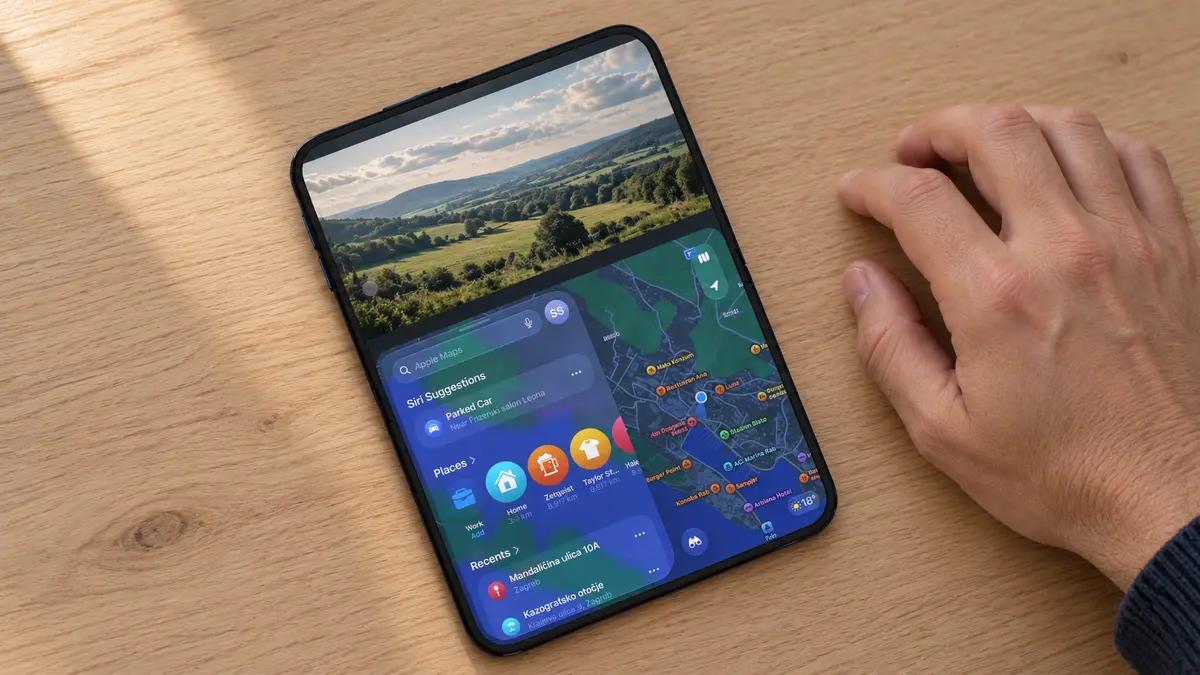
App updates are part of the story. Older apps can run in a smaller centred window on the inner display, while updated versions can use more of the available area and adapt their controls. A familiar app opening successfully therefore does not necessarily mean that its layout already takes full advantage of the Duo. The experience will continue to develop as individual developers update their software.
Some early adaptations show where that development is heading. Netflix has introduced layouts that move between the outer and inner screens, while Prime Video can place video on the raised half and supporting information below. Other developers are adapting calendars, meetings and creative tools. These examples make the folding format more tangible, although each service retains its own subscription and regional availability conditions.
A phone that can take its own position
Opening the Duo halfway creates a small tabletop arrangement: one half rests on the surface while the other faces the viewer. In supported video layouts, the image occupies the raised section and playback controls sit on the lower part. The arrangement is easy to recognise from a laptop, but here it comes from the angle of a single folding display.
Consider a quiet evening at the kitchen table, or a video call from a desk with little spare space. Being able to set the phone down changes the interaction. Hands are free, the viewing angle stays consistent, and a tap on the lower controls need not cover the picture. The benefit is convenience rather than a claim that the phone replaces a larger screen for every occasion.
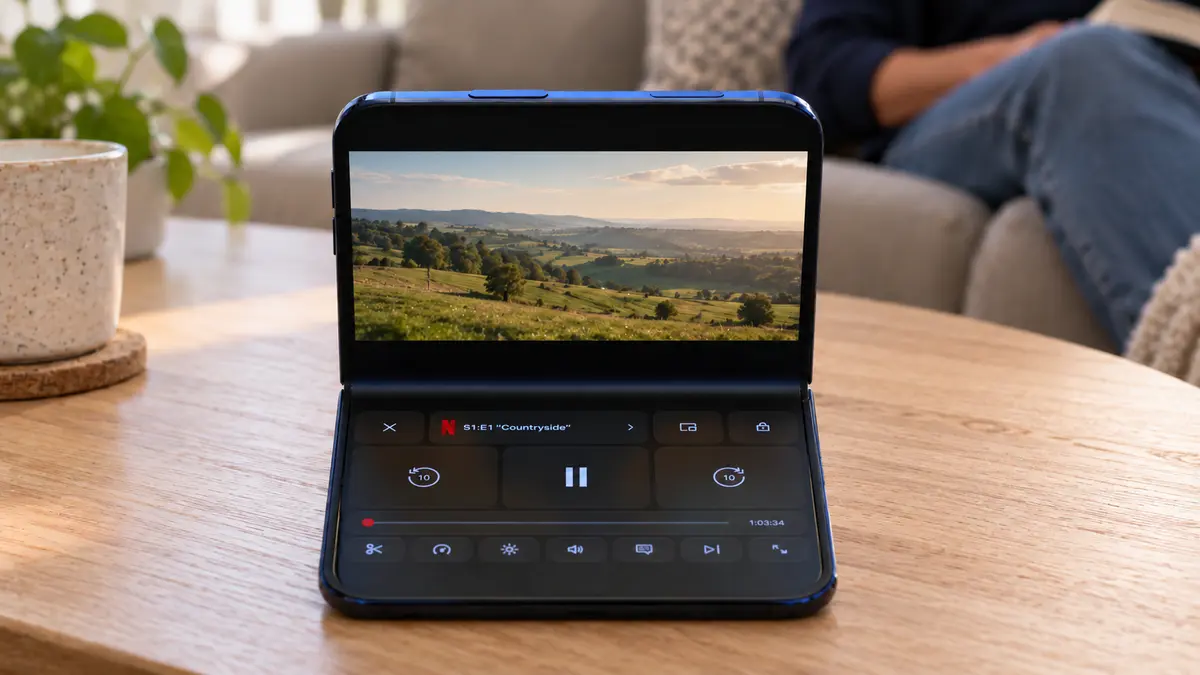
StandBy extends that idea beyond watching video. The Duo can show a clock, photographs or widgets on either display, including when it is running on battery power. In its standing configuration, it becomes an object that can be glanced at across a desk. The same handset that carried a conversation a moment earlier can then display a calendar or a photograph without being held.
The under-display camera on the inner screen also supports calls in these positions. Keeping the device stable and the lens at a sensible angle still matters, but the hinge provides a useful starting point. A clean, level surface is enough for the documented freestanding poses; there is no need to balance the phone against a cup or another improvised support.
Cameras that use both sides of the phone
On the rear, the Duo has two 48-megapixel cameras: a main camera and an ultra-wide camera. The main camera covers ordinary photographs and offers a 2× optical-quality framing option using its sensor. The ultra-wide takes in a broader scene and supports macro photography for close subjects. The two-lens arrangement remains clear: the 2× option does not add a separate telephoto lens.
The more distinctive change is the relationship between the cameras and the displays. With Duo Preview, the person being photographed can see the composition on the outer screen. A family portrait becomes a more shared process, because the people in front of the lens can adjust their position without waiting for a description from behind the phone. The outer screen can also provide a preview when taking a selfie with the rear cameras.
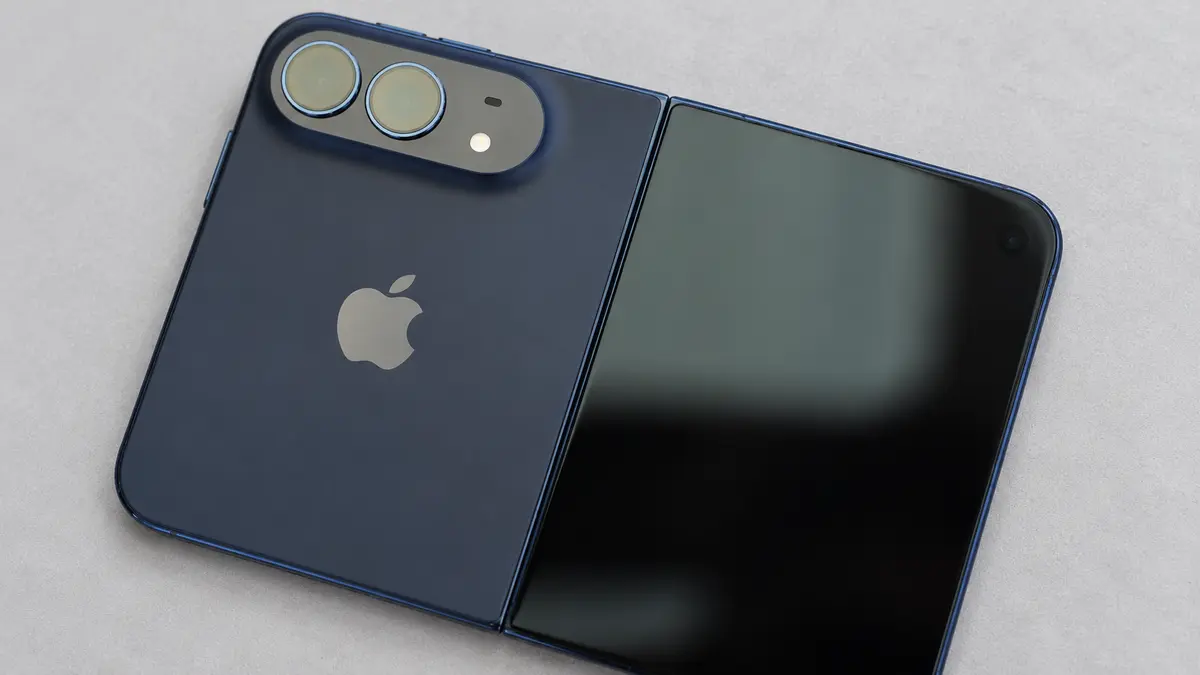
Smart Take adds automatic capture when people are ready, and Kid Cue uses animations on the outer screen to attract a child’s attention. These features address familiar photographic problems: someone is left out because they are holding the camera, or a small child looks elsewhere at the crucial moment. Their usefulness will depend on the scene, but the underlying idea follows naturally from having a screen beside the rear cameras.
The outer front camera is a 12-megapixel Center Stage camera, while the inner camera sits beneath the folding display for FaceTime and other supported uses. For video, the main rear camera supports 4K Dolby Vision recording at up to 120 frames per second, allowing slow-motion playback from high-resolution footage. Those capabilities describe recording options; they do not by themselves establish image quality in every light. The strongest part of the camera story is how the shape creates new ways to frame a shot.
Power and battery life across two screens
The A20 Pro chip powers the Duo, with a vapour chamber helping to spread heat inside the device. That cooling system has a practical role when a demanding task continues for several minutes: editing video, playing a game or running complex processing creates heat that must be managed. The larger display makes those activities more inviting, so sustained performance matters alongside the speed of opening an app.
Two batteries, one in each side of the body, operate together as a single power system. Apple rates typical use at up to 24 hours, based on a test profile that uses the inner and outer displays equally and combines active and passive activities. Separate video-playback figures reach up to 31 hours on the inner screen or 44 hours on the outer screen.
Those figures describe different tests. Watching downloaded video, streaming over a mobile connection and using navigation while travelling place different demands on a phone. Brightness, signal strength and the time spent on each screen also affect the result. The equal-screen test provides useful context for the typical-use claim, while an individual day may lean much more heavily towards one display.
Wired charging can reach up to 50% in around 20 minutes under the stated test conditions. Achieving that rate requires the appropriate USB-C charging setup: Apple specifies its compatible dynamic adapter or a suitable third-party adapter capable of 60 W with USB Power Delivery 3.2 and Adjustable Voltage Supply. These are the power-negotiation features that let the charger and phone agree how to supply energy. A wattage printed on an adapter is only part of the requirement.
MagSafe and Qi2 wireless charging are also supported at up to 25 W. A USB-C charging cable is included, while a mains adapter is separate. For an owner, the useful result is a choice between plugging in and placing the phone on a compatible wireless charger, with charging speed affected by the complete setup and operating conditions.
The engineering behind the fold
The exterior combines a titanium frame with Ceramic Shield protection on the outer surfaces. Inside, the folding display uses a different layered construction that allows it to bend, while the hinge supports its centre when open. The design has to accommodate two opposing requirements: flexibility during movement and support when the screen is being used.
This is why the hinge deserves attention as part of the product’s identity. It determines how the two halves align, how the phone sits on a table and how consistently the inner display is supported. Long-term smoothness and wear require experience over time; launch specifications and photographs cannot settle those questions. The published IP68 rating describes tested dust and water resistance, with resistance able to diminish through wear.
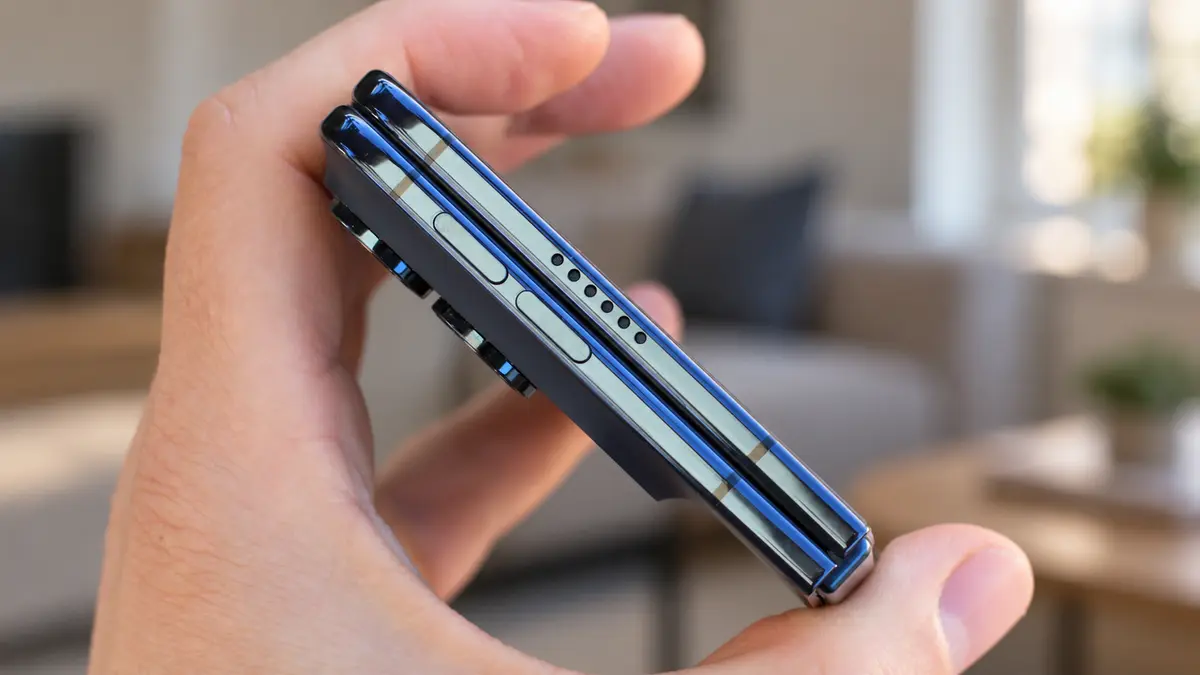
Touch ID is built into the side button, giving the phone fingerprint authentication in both open and closed use. Accessories also follow the new geometry: a fitted case has to accommodate two moving halves and their displays. Apple offers a two-part case and a folio with a kickstand.
Apple Pencil with USB-C adds another possibility for the larger screen, particularly for annotation and sketching. As of 26 October 2026, support is still described as coming later in the year. That makes it a planned extension of the Duo’s role, with availability dependent on the promised software support.
A new place in the iPhone family
The iPhone Duo launches in Night Sky and Star White, with storage options from 256 GB to 2 TB. Apple’s announced US starting price is US$1,999 for the 256 GB version. This is a US market figure; pricing and availability in Moldova need to come from a confirmed local offer. The international release date alone does not establish when a particular seller will have stock.
For use in Moldova, one concrete detail deserves attention: the Duo uses eSIM worldwide and has no physical SIM tray. An eSIM stores the mobile subscription digitally, so activating an existing number depends on the operator’s support. This is a straightforward service-compatibility point that sits alongside the phone’s much more visible design changes.
Language support also varies by feature. The Duo supports Apple Intelligence, but the newer Siri AI is currently an English-language beta with account-region requirements and an enrolment process that can involve a waitlist. Romanian and Russian are not currently listed among Apple Intelligence’s supported languages. These limitations concern the AI features and should be distinguished from the phone’s general interface language options.
The Duo’s clearest audience is someone who regularly wants more room from the device already in their hand: more of a photograph, a second app beside the first, or a video that can stand on a table. The extra weight, folded depth and premium price are part of that proposition. For someone whose phone use is mainly brief messages and calls, those additional roles may matter less.
What makes this introduction interesting is the continuity between those moments. A quick message can become a longer reading session; a photo can become a shared preview; a folded phone can become a small viewing screen. The iPhone Duo gives that change a physical form. To explore the wider smartphone market in Moldova, visit IVO and its smartphones category, where any specific model’s details can be considered in the context of an actual listing.